
The book is many years old, but still relevant. Redis has evolved a lot, but most of that has been in the form of internal improvements, new advanced features (like lua scripting) and awesome new data types. The best way to learn Redis is still to start by understanding the fundamentals presented in this book.
This open access book offers a concise and gentle introduction to finite element programming in Python based on the popular FEniCS software library. Using a series of examples, including the Poisson equation, the equations of linear elasticity, the incompressible Navier - Stokes equations, and systems of nonlinear advection - diffusion - reaction equations, it guides readers through the
This text is used in a mathematical software course at VMI that provides an introduction to Matlab and Mathcad. However, Troy Siemers also intends it to be a course book instead of an all inclusive resource. He encourages his students to take full advantage of the built-in help capabilities of these software packages, additional texts (he keeps a few in a small library that is always ava
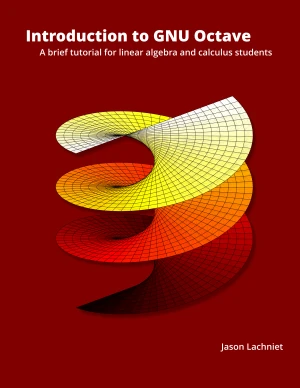
This guide introduces GNU Octave, a powerful, open-source software environment for scientific computing and numerical problem-solving. Through practical applications in linear algebra and calculus, readers will learn to leverage Octave's computational capabilities while strengthening their mathematical understanding. The text demonstrates Octave's functionality across key mathematical do
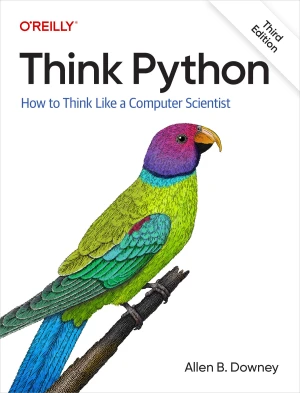
Think Python is an introduction to Python programming for beginners. It starts with basic concepts of programming; it is carefully designed to define all terms when they are first used and to develop each new concept in a logical progression. Larger pieces, like recursion and object-oriented programming, are divided into a sequence of smaller steps and introduced over the course of sever
This book is based on "First semester in Numerical Analysis with Julia". The contents of the original book are retained, while all the algorithms are implemented in Python (Version 3.8.0). The authors present Python as an open source (under OSI), interpreted, general-purpose programming language that has a large number of users around the world. They note that Python ranked third in Augu
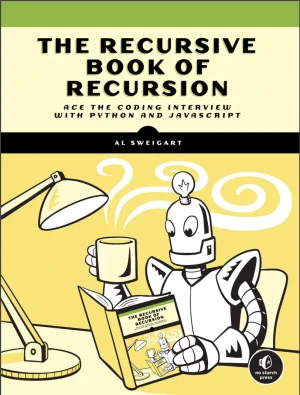
Recursion has an intimidating reputation: it's considered to be an advanced computer science topic frequently brought up in coding interviews. But there's nothing magical about recursion. The Recursive Book of Recursion uses Python and JavaScript examples to teach the basics of recursion, exposing the ways that it's often poorly taught and clarifying the fundamental principles of all rec
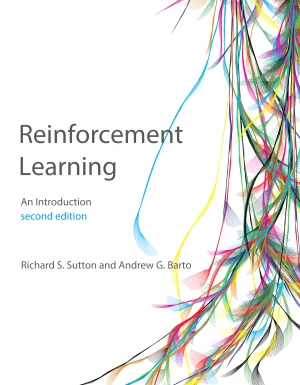
Reinforcement learning, one of the most active research areas in artificial intelligence, is a computational approach to learning whereby an agent tries to maximize the total amount of reward it receives while interacting with a complex, uncertain environment. In Reinforcement Learning, Richard Sutton and Andrew Barto provide a clear and simple account of the field's key ideas and algori
Scientific computing utilizes computers to aid in scientific tasks such as data processing and digital simulations, among others. The well-developed field of computational chemistry is part of scientific computing and focuses on utilizing computing to simulate chemical phenomena and calculate properties. However, there is less focus in the field of chemistry on the data processing side o
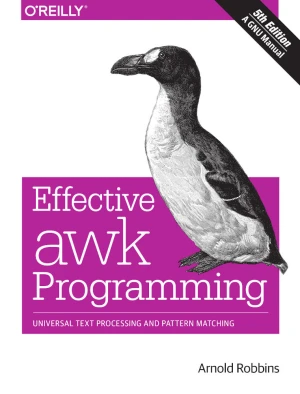
When processing text files, the awk language is ideal for handling data extraction, reporting, and data-reformatting jobs. This practical guide serves as both a reference and tutorial for POSIX-standard awk and for the GNU implementation, called gawk. This book is useful for novices and awk experts alike. In this thoroughly revised 5th edition, author and gawk lead developer Arnold Robbi