
Incredibly useful, knowledge graphs help organizations keep track of medical research, cybersecurity threat intelligence, GDPR compliance, web user engagement, and much more. They do so by storing interlinked descriptions of entities - objects, events, situations, or abstract concepts - and encoding the underlying information. How do you create a knowledge graph? And how do you move it f
Innovation and competition are driving analysts and data scientists toward increasingly complex predictive modeling and machine learning algorithms. This complexity makes these models accurate but also makes their predictions difficult to understand. When accuracy outpaces interpretability, human trust suffers, affecting business adoption, regulatory oversight, and model documentation. B
This book bridges theoretical computer science and machine learning by exploring what the two sides can teach each other. It emphasizes the need for flexible, tractable models that better capture not what makes machine learning hard, but what makes it easy. Theoretical computer scientists will be introduced to important models in machine learning and to the main questions within the fiel

This book originated from lecture notes developed by the lead author for a course in applied numerical methods, initially designed for Civil Engineering majors, and later expanded to include Mechanical Engineering. The primary objectives of the text are to introduce the fundamental concepts of numerical methods and to provide a thorough, integrated guide to using MATLAB within an enginee

How to Think Like a Computer Scientist is an introductory programming book based on the OCaml language. It is a modified version of Think Python by Allen Downey. It is intended for newcomers to programming and also those who know some programming but want to learn programming in the function-oriented paradigm, or those who simply want to learn OCaml. OCaml is a powerful high-level progra
If you know how to program with Python and also know a little about probability, you're ready to tackle Bayesian statistics. With this book, you'll learn how to solve statistical problems with Python code instead of mathematical notation, and use discrete probability distributions instead of continuous mathematics. Once you get the math out of the way, the Bayesian fundamentals will beco
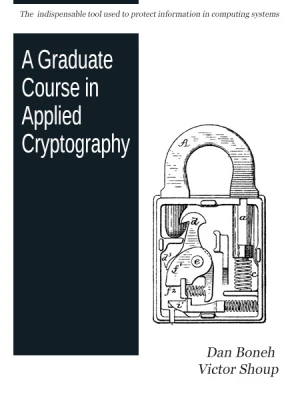
Cryptography is an indispensable tool used to protect information in computing systems. It is used everywhere and by billions of people worldwide on a daily basis. It is used to protect data at rest and data in motion. Cryptographic systems are an integral part of standard protocols, most notably the Transport Layer Security (TLS) protocol, making it relatively easy to incorporate strong
Microservices is an architectural style in which large, complex software applications are composed of one or more smaller services. Each of these microservices focuses on completing one task that represents a small business capability. These microservices can be developed in any programming language. This book covers Microservices best practices for Java. This IBM Redbooks publication co
Every modern technology-driven organization understands data is one of its most valuable assets. It's no surprise, then, that the protection of that data has become an increasing concern. This concern is made much more complex, though, because organizations no longer store all their data in a single location. With the advent of modern cloud - virtualized, on-premises, hybrid, full cloud,

The digital technology explosion has blown everything to bits-and the blast has provided new challenges and opportunities. This second edition of Blown to Bits delivers the knowledge you need to take greater control of your information environment and thrive in a world that's coming whether you like it or not. Straight from internationally respected Harvard/MIT experts, this plain-Englis