
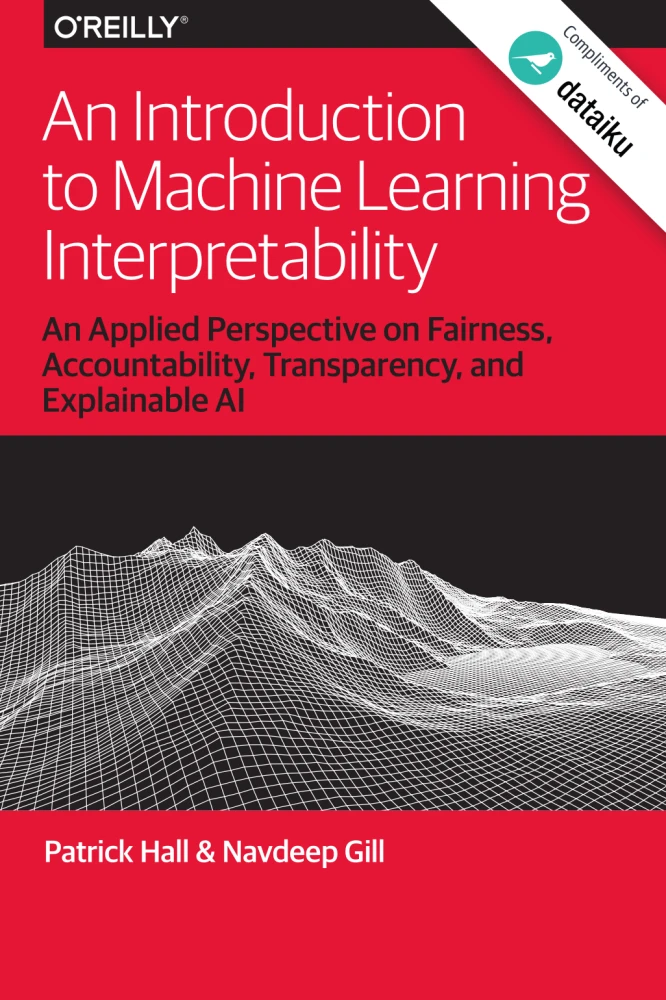
An Introduction to Machine Learning Interpretability
An Applied Perspective on Fairness, Accountability, Transparency, and Explainable AI

Book Details
| Authors | Patrick Hall, Navdeep Gill |
| Publisher | O'Reilly Media |
| Published | 2018 |
| Edition | 1st |
| Paperback | 46 pages |
| Language | English |
| ISBN-13 | 9781492033158, 9781492033141 |
| ISBN-10 | 1492033154, 1492033146 |
| License | Compliments of Dataiku |
Book Description
Innovation and competition are driving analysts and data scientists toward increasingly complex predictive modeling and machine learning algorithms. This complexity makes these models accurate but also makes their predictions difficult to understand. When accuracy outpaces interpretability, human trust suffers, affecting business adoption, regulatory oversight, and model documentation.
Banking, insurance, and healthcare in particular require predictive models that are interpretable. In this ebook, Patrick Hall and Navdeep Gill from H2O.ai thoroughly introduce the idea of machine learning interpretability and examine a set of machine learning techniques, algorithms, and models to help data scientists improve the accuracy of their predictive models while maintaining interpretability.
- Learn how machine learning and predictive modeling are applied in practice
- Understand social and commercial motivations for machine learning interpretability, fairness, accountability, and transparency
- Explore the differences between linear models and more accurate machine learning models
- Get a definition of interpretability and learn about the groups leading interpretability research
- Examine a taxonomy for classifying and describing interpretable machine learning approaches
- Learn several practical techniques for data visualization, training interpretable machine learning models, and generating explanations for complex model predictions
- Explore automated approaches for testing model interpretability
This book is published as open-access, which means it is freely available to read, download, and share without restrictions.
If you enjoyed the book and would like to support the author, you can purchase a printed copy (hardcover or paperback) from official retailers.
Download and Read Links
Share this Book
[localhost]# find . -name "*Similar_Books*"
Introduction to Data Science
Introduction to Data Science: Data Analysis and Prediction Algorithms with R introduces concepts and skills that can help you tackle real-world data analysis challenges. It covers concepts from probability, statistical inference, linear regression, and machine learning. It also helps you develop skills such as R programming, data wrangling, data vi

Android on x86
Android on x86: an Introduction to Optimizing for Intel Architecture serves two main purposes. First, it makes the case for adapting your applications onto Intel’s x86 architecture, including discussions of the business potential, the changing landscape of the Android marketplace, and the unique challenges and opportunities that arise from x86 de
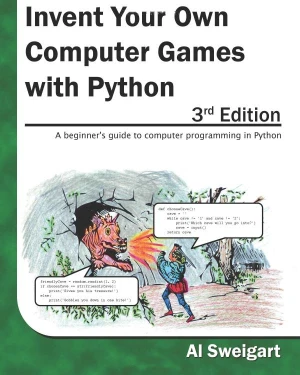
Invent Your Own Computer Games with Python, 3rd Edition
Invent Your Own Computer Games with Python teaches you how to program in the Python language. Each chapter gives you the complete source code for a new game, and then teaches the programming concepts from the examples. Games include Guess the Number, Hangman, Tic Tac Toe, and Reversi. This book also has an introduction to making games with 2D graph
Think C++
Think C++ is an introduction to programming using the C++ language. Allen Downey originally wrote it to help students prepare for the Computer Science AP exam when the exam covered C++.

An Introduction to Matlab and Mathcad
This text is used in a mathematical software course at VMI that provides an introduction to Matlab and Mathcad. However, Troy Siemers also intends it to be a course book instead of an all inclusive resource. He encourages his students to take full advantage of the built-in help capabilities of these software packages, additional texts (he keeps a f
How To Manage a Redis Database
This book aims to provide an approachable introduction to Redis concepts by outlining many of the key-value store's commands so readers can learn their patterns and syntax, thus building up readers' understanding gradually. The goal for this book is to serve as an introduction to Redis for those interested in getting started with it, or key-value s